
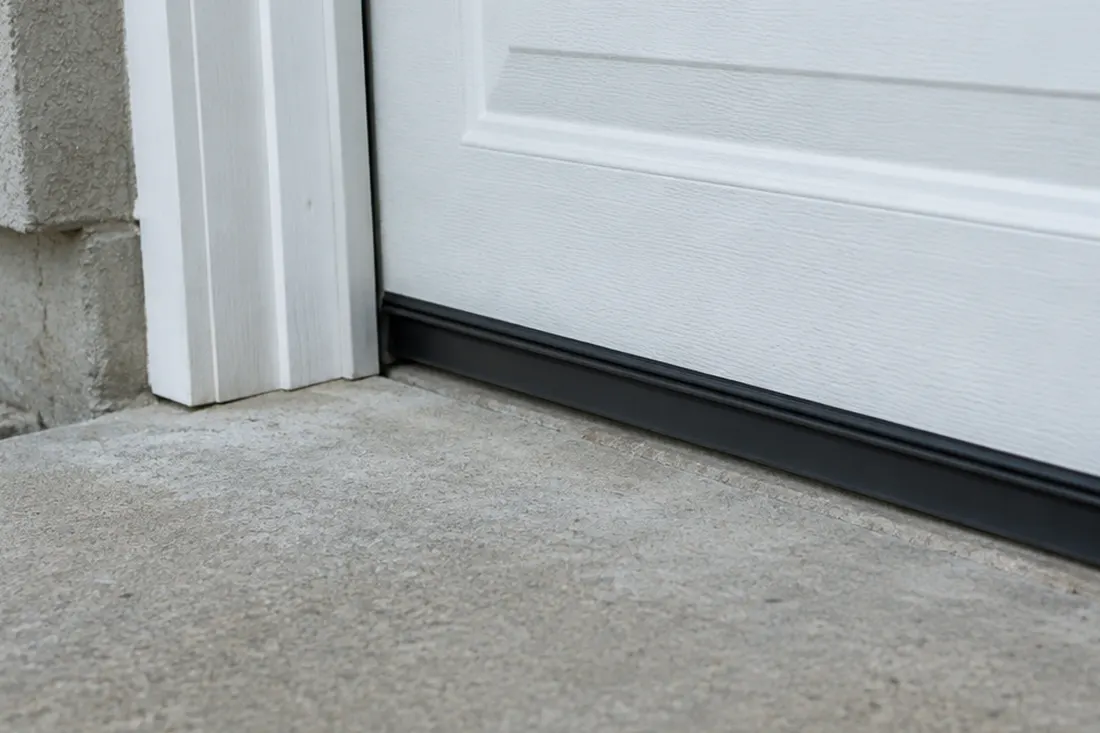
Check the bottom seal and the seals along the sides and top before the cold arrives. Replace any that are cracked, flattened or brittle. This Old House suggests silicone or EPDM rubber for cold climates, because vinyl can turn brittle. Measure, cut to length and press it in with no gaps.
Why the seals matter in winter
A garage door has up to three seals: one along the bottom, and strips along the sides and top. Together they keep out wind, snow, leaves and water. This Old House points out that a door seal works like a refrigerator seal, keeping cold air out, and says seals matter most when the garage shares a wall with living space.
Seals wear out. This Old House advises checking them for ripping, compression, bending or wear, and replacing them as soon as they show deterioration.
Check what you have first
- Close the door and look from inside in daylight. Any light at the edges is a gap.
- Press on the bottom seal. It should spring back, not stay flat or crack.
- Look for torn rubber, hardened strips and loose vinyl on the sides and top.
- Check that the bottom seal slides freely in its channel and is not stuck with dirt or ice.
- Note whether the floor is level. A seal cannot fix an uneven floor.
Pick a material that stays flexible
For cold climates, This Old House suggests silicone or EPDM rubber, which stay flexible in freezing temperatures, and advises avoiding vinyl that can become brittle in extreme cold. Match the seal type to the channel on your door. Many doors take a bulb or T-shaped strip that slides into a track on the bottom panel, and others use a different retainer.
If you are not sure, take a photo of the bottom edge, or a short piece of the old seal, to the store, or send it to us before you buy.
How to replace the bottom seal
Close the door and unplug the opener
Keep people clear. The door stays closed during this job.
Remove the old seal
Slide it out of the channel, or remove the fasteners. Clear dirt and ice from the channel.
Measure the door width
Measure the old seal or the door and cut the new one to length with a utility knife or scissors.
Slide or fasten the new seal
Feed it into the channel from one end. Do not stretch it, and make sure it reaches both corners.
Check the fit
The seal should sit tight on the floor with no gaps and no folds.
Test the door
Reconnect the opener and run the door. If it reverses early or the opener strains, the seal is too tall and a technician should check the opener limits.
For the sides and top, This Old House says to measure the height and width of the door frame and attach vinyl or foam weatherstripping so it touches the door when closed. For more detail see weatherstripping the sides and top.
Mistakes to avoid
Do not stretch a seal to make it fit. It will shrink back and leave a gap at the corner. Do not leave any lube or oil on the seal, because it collects dirt. Do not force a thicker seal into a thin channel. And do not skip the clean-up: a channel packed with grit will hold a new seal poorly.
A new seal does not fix a bent panel, a worn track or a floor that has moved. If the door still leaves a gap, freeze-thaw movement in the slab may be the cause.
When to call a technician
Call if the bottom edge is bent, the seal channel is damaged, the door reverses or does not close fully with the new seal, or you hear a pop or see a crooked door. Do not adjust springs or cables to fix a gap. See garage door repair and new garage doors if the door is worn out.
Who to call
Emil Garage Doors repairs garage doors, springs, cables and openers and installs new doors in Illinois, including Bolingbrook, Orland Park and Waukegan. Call or send your details and a photo of the edge, and we book the soonest visit.
Questions people ask
Which weatherstripping suits cold weather?
This Old House suggests silicone or EPDM rubber for cold climates because they stay flexible in freezing temperatures, and advises avoiding vinyl that can become brittle.
How often should garage door weatherstripping be replaced?
There is no fixed date. This Old House advises checking seals regularly and replacing them as soon as they are ripped, compressed, bent or worn.
Do I need seals on the sides and top as well?
Yes, for a tight door. The bottom seal does the most work, but strips on the sides and top stop drafts and blowing snow.
Why is there still a gap under my garage door after a new seal?
The floor may be uneven, or the bottom panel may be bent. A new seal cannot fix either one, and a technician should check the door.
Services that fit this problem
Garage door and gate help near you
We repair and install in these cities. Each page has local notes, prices and reviews.