
Find where cold air and light get in, then replace the seal that has worn out: the rubber at the bottom, the flexible strip along the sides, or the strip across the top. Match the new seal to your door, work from the inside, and leave the springs, cables and bottom brackets alone.
Where a garage door leaks
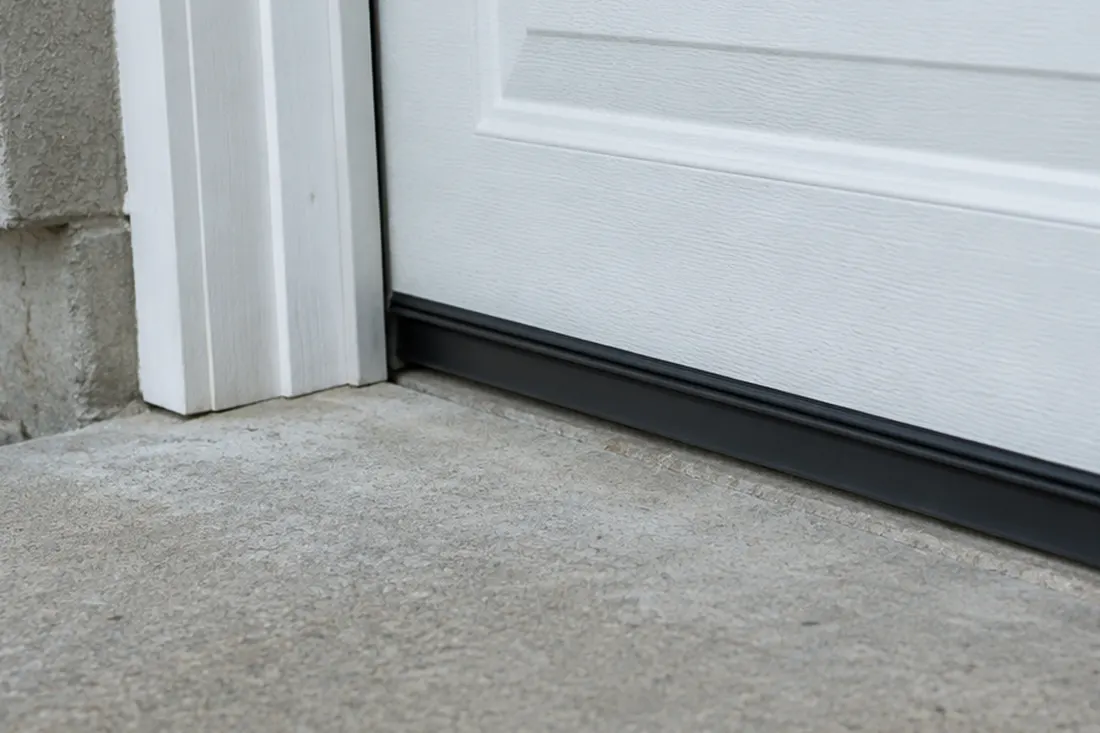
A garage door has three seal zones: the bottom edge against the floor, the two sides against the frame, and the top across the header. A gap in any of them lets in cold air, snow and dust. The U.S. Department of Energy points out that air leaks around doors are among the most obvious in a house, and that insulation does not stop moving air. Sealing the gap is what stops the draft.
The department's air sealing guide lists weather-stripping materials for doors, including tension seals, felt, reinforced foam, rubber tape, door sweeps, and bulb or fin seals. A garage door uses a few of these, mostly a rubber or vinyl bottom seal and a vinyl strip for the sides and top.
Find the gaps first
Close the door and turn off the garage lights
Do this on a bright day or have a helper shine a flashlight along the edges from outside.
Look for light
Any line of light along the bottom, sides or top is a gap. Mark each one with painter's tape.
Feel for drafts
On a cold or windy day, run your hand along the edges. A moving stream of air is a leak.
Check the seal itself
Look for rubber that is cracked, flattened, torn, stiff or missing, and for strips that have pulled away from the door.
Check the floor line
A seal can be fine while the slab is uneven. A gap that changes along the width points to the floor, not the rubber.
What each seal does
| Seal | Where it sits | Signs it is worn | Usual fix |
|---|---|---|---|
| Bottom seal | Along the bottom edge, against the floor | Daylight under the door, tears, frozen to the slab | Replace the strip; see ice on the bottom seal |
| Side seals | On the frame, touching the door edges | Gaps, hardened vinyl, strip pulled loose | Replace or press back into the stop molding |
| Top seal | Across the header above the door | Light or drafts at the top of the closed door | Replace the strip along the header |
Seal types differ by door. Check your owner's manual or the door label for the right profile.
Replace a worn seal
Take a short piece of the old seal to the store, or note the brand and model of the door. Seals come in different profiles and widths, and a loose fit will let air through. Clean the area where the new seal goes so it seats firmly.
Work from inside the garage on a stable step stool. Most side and top strips pull out of a groove or are held by a few nails or screws. Press the new strip in so it lightly touches the door when closed, without squeezing so tight that the door drags.
DASMA warns that springs are under high tension and that only trained door technicians should loosen or adjust bottom brackets, red fasteners, cables or supports. The bottom bracket sits right where the bottom seal ends, so if the strip is stuck behind a bracket, leave it and call. See spring repair.
Close and open the door by hand a few times after the swap. It should move freely and the new seal should not bunch or fold under the edge.
Quick answers
How do I know which garage door seal needs replacing?
Close the door, turn off the garage lights and look for light along the bottom, sides and top. Any line of light or a stream of cold air marks a seal that no longer fits.
Can I replace garage door weatherstripping myself?
Often yes for the side and top strips, working from inside. Leave springs, cables and bottom brackets to a technician, as DASMA advises.
Does weatherstripping make a garage door warmer?
It cuts drafts. The Department of Energy says insulation does not stop moving air, so sealing the gaps is a separate job from adding insulation.
How often should garage door seals be checked?
Look at them each fall and again after the first hard freeze. DASMA advises a monthly look at the door system, which is a good moment to check the seals.
What to avoid
- Do not stuff foam or rags in a gap that the door has to travel through.
- Do not cut a seal short; a short seal leaves a gap at the end.
- Do not remove a bottom bracket or fastener to reach a seal.
- Do not use a sealant that glues the door to the frame or the floor.
When a seal is not enough
If the door is warped, the sections have gaps between them, or the panels are thin and cold to the touch, new seals only solve part of the draft. See insulated garage doors for Massachusetts winters to compare. For a door that is crooked or hard to move, see garage door repair.
Emil Garage Doors repairs garage doors, springs, cables and openers and installs new doors in Massachusetts, including Fall River, Weymouth and Brockton. Call or send your details with a photo of the gap and we book the soonest visit.
Our related services
Cities near you
We repair and install in these cities. Each page has local notes, prices and reviews.