
If your opener died after a storm, check the outlet, the breaker and the wall control first. Lightning can send a surge through the power line and damage the opener's circuit board, remotes or safety sensors some distance from the strike. If the checks do not bring it back, call a technician and keep the door closed and clear.
Quick answers
Can lightning damage a garage door opener?
Yes. The National Weather Service says lightning generates electric surges that can damage electronic equipment some distance from the actual strike. The circuit board, receiver, wall control and sensors are the usual victims.
Will a surge protector save my opener?
It helps against ordinary surges, but the National Weather Service says typical surge protectors will not protect equipment from a lightning strike. Chamberlain recommends one for openers made after 1994.
Why do my remotes not work after the storm?
The remote battery or the opener's receiver may be damaged. If the wall control still works, the opener has power and the receiver or remote is the likely fault.
Should I unplug the opener during a thunderstorm?
The National Weather Service says not to unplug equipment during a thunderstorm, because there is a risk you could be struck. Check the opener after the storm.
The full explanation
What a surge does to an opener
The National Weather Service says lightning generates electric surges that can damage electronic equipment some distance from the actual strike. A garage door opener is electronics on a power line, with wires running to a wall control and to two safety sensors, so a surge can enter in more than one place.
The usual victims are the circuit board, the receiver that reads your remotes, the wall control and the sensors. The motor and the door itself are normally fine, which is why a dead opener on a healthy door is often a repair and not a new door.
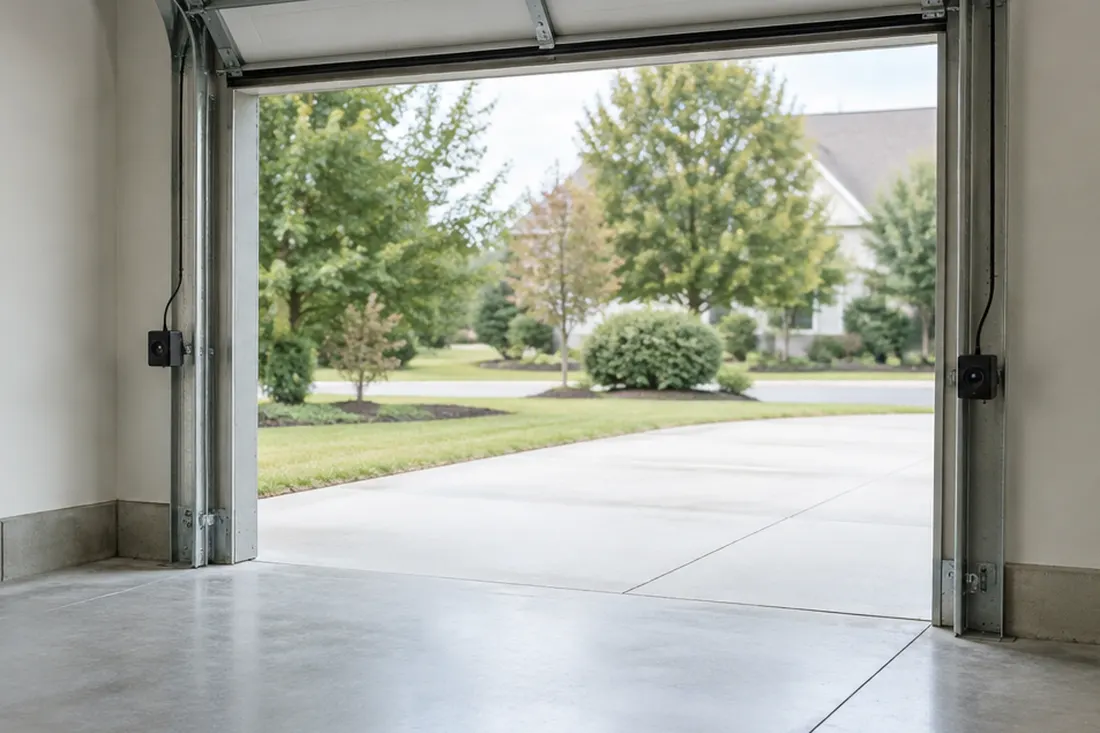
What you see and what it likely means
| What you see | Likely cause | What to do |
|---|---|---|
| No light, no sound, nothing from any button | No power: a tripped breaker or outlet, or a damaged board | Check the outlet and breaker, then call if power is fine |
| Wall control works, remotes do not | Remote batteries or a damaged receiver | Replace the remote battery; if still dead, call |
| Remotes work, wall control does not | Damaged wall control or its wire | Call; the wire is low voltage but is part of the system |
| Motor hums or light flickers but the door will not move | Damaged board or a door that is off balance | Stop using it and call a technician |
| Sensor lights are off or the door will not close | Sensor or sensor wire damaged | Check alignment and lens, then call |
We confirm the cause on site. A surge can damage more than one part.
Five checks, in this order
Test the outlet
Plug in a lamp or a phone charger. If it has no power, check the breaker panel and any GFCI outlet on the same circuit.
Look at the wall control
Check that it lights up and that no wires are loose at the control or the opener.
Check the sensors
Both sensor lights should be on. Wipe the lenses and make sure they still face each other.
Replace the remote battery
A weak battery looks like a dead remote. Try the wall control and a second remote.
Reset the power
Unplug the opener, wait a few minutes, plug it back in and try once. Do not open the opener's cover.
Safety first
Use the red release handle only when the door is fully closed, and only if nothing looks broken. If you hear a bang, see a broken spring or a loose cable, or the door hangs crooked, leave it alone. Do not adjust a spring or cable yourself, and do not bypass a sensor. See garage door opener repair.
Also remember the National Weather Service says not to unplug equipment during a thunderstorm, because there is a risk you could be struck. Check the opener after the storm has passed.
Can you protect an opener next time?
Chamberlain's support site recommends a surge protector as extra defense for openers made after 1994, and says it covers the AC power line, the control panel and the safety reversing sensors. A protector costs less than a replacement board and is a reasonable part of the setup.
It is not a promise. The National Weather Service says typical surge protectors will not protect equipment from a lightning strike. Think of a protector as help against ordinary surges, not as a shield from a direct hit.
Repair or replace the opener?
A damaged board, receiver or sensor is often cheaper to replace than the whole opener. If the opener is old, noisy or not made any more, replacement can be the better value. With us, a belt-drive opener with battery backup, installed, is $550 to $900, and the final price is confirmed after we see the door. See opener installation cost and remote and keypad problems for more.
If a storm hit your home, ask your insurer how it handles surge damage to a garage door opener. Photograph the opener, the date and the storm damage before repairs.
Who to call
Emil Garage Doors repairs garage doors, springs, cables and openers and installs new doors in Texas, including Killeen, College Station and Tyler. Call or send your details with the opener's brand and what you see, and we book the soonest visit.
Services that fit this problem
Garage door and gate help near you
We repair and install in these cities. Each page has local notes, prices and reviews.