
Choose a sliding gate when you have room along the fence line but not in front of the gate, or when the driveway slopes. Choose a swing gate when you have a level, clear arc to open into and little room beside the opening. Either type needs a listed operator with two independent entrapment protection means.
How each gate works
A swing gate has one or two leaves that hinge on posts and open inward or outward. A sliding gate moves sideways along the fence line, either on a track or wheels or as a cantilever that hangs from its frame. Both can be driven by an operator that opens and closes them on a command from a remote, keypad or intercom.
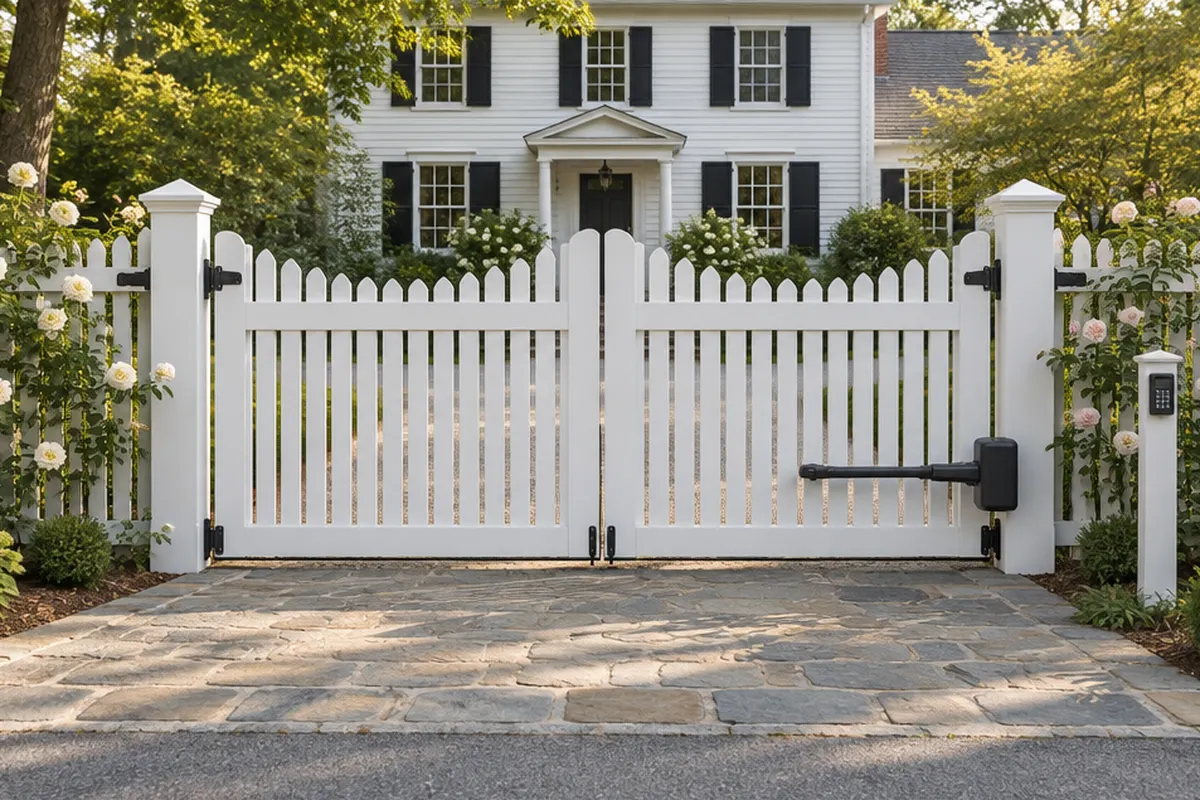
Side by side
Sliding gate
- Needs room along the fence line to open
- Clears the driveway completely when open, according to Delta Scientific
- Better suited to uneven or sloped driveways, according to ALEKO
- Track versions need regular cleaning; cantilever versions have fewer parts touching the ground
- Exposed rollers need guards
Swing gate
- Needs room to swing open inward or outward
- Needs a flat surface to open smoothly
- Can be pushed by wind if not secured
- Depends on hinges and the operator, so check them
- Needs clearance from nearby walls, posts and cars
Measure the space first
For a sliding gate, measure the fence line beside the opening. The gate has to retract fully out of the way, so you need clear room for its whole length, plus the post and operator. For a swing gate, measure the arc in front of the opening, including cars, steps and plantings, and note which way the ground falls.
DASMA's guidance says adequate clearance should be provided between a swinging gate and adjacent structures to reduce the risk of entrapment. If the swing area is tight or sloped, a slider is often easier. If the fence line is short, a swing gate may be the only option.
Safety and upkeep
Both types need an operator listed to UL 325 and at least two independent entrapment protection means. A sliding gate should work smoothly in both directions before an operator is added, and DASMA says sliding gates should not have gaps below 6 feet that let a 2 1/4 inch sphere through, including the part of the fence the gate covers when open. Exposed roller points near the ground need guards.
For upkeep, a track must stay clear of dirt and debris, and swing gates depend on hinges that carry the leaf. See sliding gate off track, swing gate opener not working and the electric gate maintenance checklist.
Questions that decide it
- Do you have more room beside the opening or in front of it?
- Does the driveway slope up or down toward the gate?
- Is the swing area free of cars, steps and plants?
- Does wind blow straight at the opening?
- Do you want the gate fully clear of the driveway when it is open?
- Would a track in the ground be a problem for your driveway?

The verdict
There is no single winner. A slider wins on tight or sloped driveways, and a swing gate wins when you have a level arc and little fence line. Many sites suit either, so choose on the space you measured, your budget and the look you want.
Price and next step
Price depends on the width, the material, the operator, the posts and foundation, and any electrical work, so ask any quote to list each of those. See driveway gate installation cost.
Emil Garage Doors repairs and installs gates and operators for Southern California homes, for example in La Verne, Brea and Oceanside. See gate repair, then call (213) 340-4232 or send the estimate form with your opening width and a photo.
Questions people ask
Is a sliding gate better than a swing gate?
Neither is better for every driveway. A sliding gate suits sloped or tight driveways with room along the fence line, and a swing gate suits a level driveway with a clear arc.
How much space does a swing gate need?
Enough clear, level room to swing open fully inward or outward. Measure the arc, including cars, steps and plants.
What is a cantilever gate?
A sliding gate that hangs from its frame instead of rolling on a ground track, so it has fewer parts touching the ground, according to ALEKO.
Do both gate types need safety sensors?
Yes. UL 325 requires at least two independent entrapment protection means for each entrapment zone on both types, according to DASMA.
Our related services
City pages near you
We repair and install in these cities. Each page has local notes, prices and reviews.
Read next
Sources
- ALEKO: Sliding Gate vs Swing Gate, comparing cost and features
- Delta Scientific: 5 advantages of sliding gates (space and speed)
- DASMA Technical Data Sheet 353: Vehicular Gate Operators and the ANSI/CAN/UL 325 Standard
- DASMA Technical Data Sheet 352: Automatic Vehicular Gate Operating Systems, Guidelines for Specifiers, Designers, Dealers, Installers and End Users
- DASMA: Gate System Safety brochure (be safe, be aware, installation and maintenance)