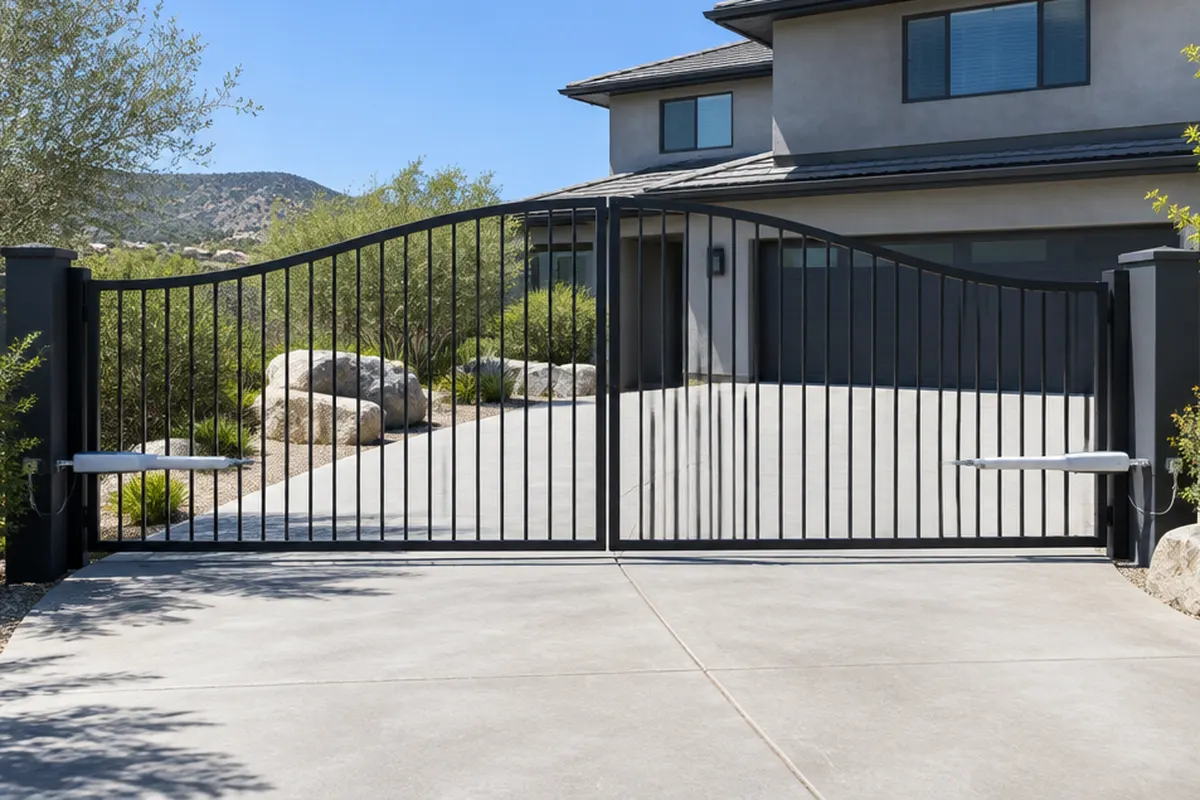
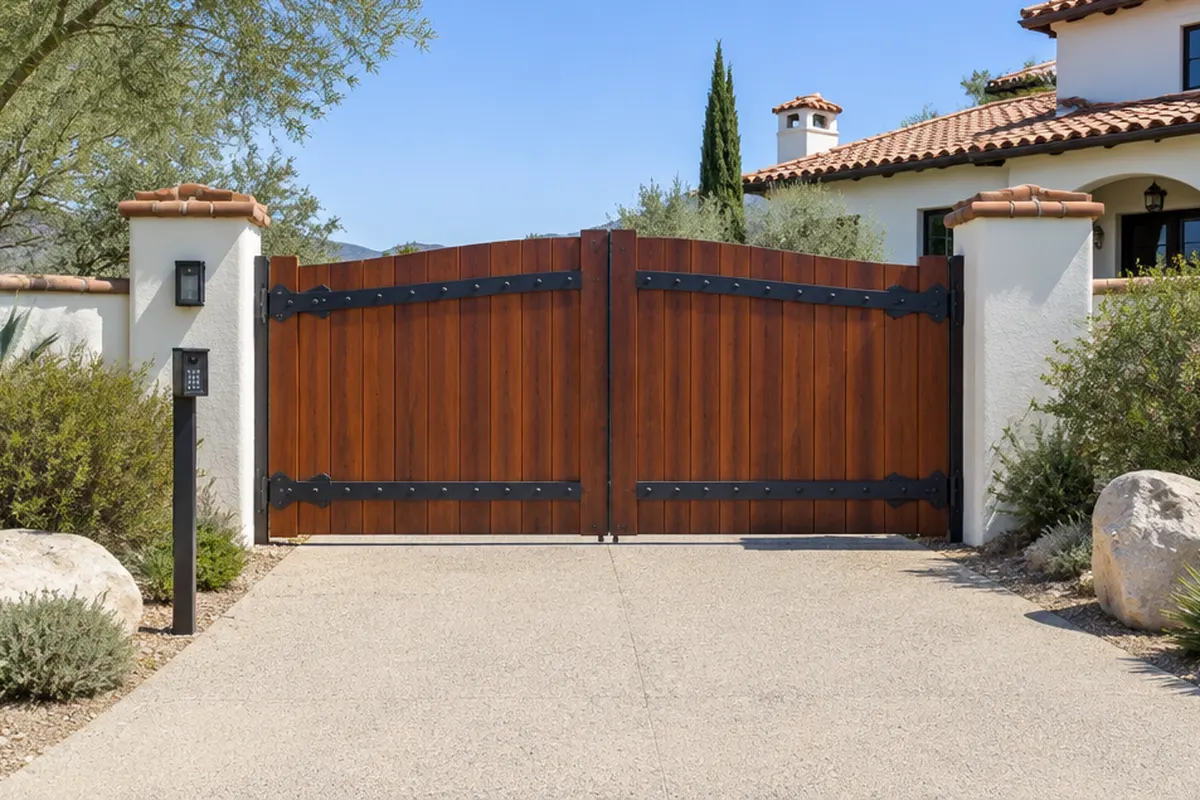
Repair a gate opener that is fairly new and has one clear fault, such as a worn battery, a remote or a sensor. Replace one that is old, keeps failing in different ways, has no available parts or lacks current safety features. DASMA says operators made before 2000 should be replaced, not repaired. The date is on the label.
Gate Opener: Repair or Replace? A Guide by Age and Problem
Start with the date on the label
Every gate operator has a label with its manufacture date. Find it before you decide anything. If the date is hard to read, a technician can find it for you.
DASMA, the trade association for door and gate operator makers, strongly recommends that operators made before 2000 not be repaired but replaced with one that meets the current UL 325 requirements. It gives two reasons: older operators lack current safety features, and most major manufacturers no longer supply replacement parts for them.
That is the one hard rule. For anything newer, the choice depends on the problem, the parts and the safety features, as below.
Repair or replace: side by side
Repair makes sense when
- The operator is fairly new and the gate moves smoothly by hand
- There is one clear fault: a remote, a keypad, a sensor, a battery or a fuse
- Parts for the model are still sold
- The operator has current entrapment protection and is listed to UL 325
- The gate and hinges are sound
Replace makes sense when
- The label date is 1999 or earlier
- The same operator fails again in different ways
- The control board or motor is the fault and parts are scarce
- The operator lacks monitored sensors or battery backup
- The gate is sagging, rusting or bending, so a new opener would not fix it
One guide to repair or replace puts the age at which a gate that fails often becomes a candidate for replacement at 15 to 20 years, and notes that a sound gate with an electrical or motor fault is a lean-to-repair case.

What you can check before you call
Some faults look serious but are simple. Try these first:
- Replace the batteries in the remotes and keypad.
- Check that the operator's power switch is on and the breaker has not tripped.
- Clear leaves, stones and branches from the path, and wipe the photo eye lenses.
- Push the gate by hand with the operator released. A stiff gate needs hinge or track work, not a new opener.
If none of that helps, see electric gate won't open or swing gate opener not working.
Why age matters for safety
Gate safety rules have tightened. DASMA says UL 325 was established in March 2000 and requires two entrapment protection devices in each entrapment zone, and that updates effective in January 2016 require the operator to monitor for the connection of any external entrapment protection device. New operators also tend to have battery backup for power outages and smartphone control.
The California Fire Code, section 503.6, also says electric gate operators, where provided, must be listed to UL 325, and that a security gate across a fire apparatus access road needs an approved means of emergency operation. Check with your city or fire district if your gate is on a fire access road.
Brands, models and parts
LiftMaster, Viking and Mighty Mule are common names on residential openers. The brand matters less than the model: ask whether the control board, the arm or the motor is still made, and whether the operator is rated for your type of gate, its weight and your daily use. A residential driveway gate is normally a Class I application under UL 325, which covers a home of one to four single-family dwellings. An apartment or shared entrance is usually a different class.
UL 325 operators are made for vehicle gates, not pedestrian gates. Pedestrians need their own safe way in.
What a replacement quote should list
- Operator brand, model and class, and that it is listed to UL 325
- Which entrapment sensors are included and where they go
- Battery backup, and what it runs on
- Whether the existing gate, hinges and posts are inspected
- Remotes, keypad and access control that are reused or replaced
- The total price before work starts
See electric gate repair and access control for what we install.

Our verdict, and where we come in
Repair a newer operator with one clear fault. Replace one that dates from 1999 or earlier, one that keeps failing or one whose parts are gone. A short inspection tells you which one you have. Emil Garage Doors repairs and replaces gate operators in Southern California, including in Tustin, Imperial and Lompoc. Call (213) 340-4232 or send the estimate form with the operator's label date and what it does, and we will give you a straight answer.
Questions people ask
When should I fix a gate opener problem myself and when should I call a pro?
Fix simple things yourself: change remote batteries, clear the path, check power and wipe sensor lenses. Call a pro for motor, arm, control board, wiring, release and sensor problems.
Is it worth repairing an old gate operator?
Not if it was made before 2000. DASMA recommends replacing those, since they lack current safety features and parts are mostly gone. Newer operators with one clear fault are often worth repairing.
How do I find out how old my gate operator is?
Look for the label on the operator. It shows the manufacture date. If you cannot find or read it, a technician can.
Do LiftMaster, Viking and Mighty Mule operators all follow UL 325?
Reputable residential operators are listed to UL 325. Check the label and the manual for the listing and class of your model.

Related services
Need help near you?
We repair and install in these cities. Each page has local notes, prices and reviews.
Keep reading
Sources
- DASMA: Old Vehicular Gate Operators, Don't Repair, Replace!
- DASMA Technical Data Sheet 353: Vehicular Gate Operators and the ANSI/CAN/UL 325 Standard
- California Fire Code section 503.6, security gates and emergency operation (GoCodeBook)
- Automated Gate Access: automatic driveway gate repair, when to repair vs replace
Need it looked at?
Call (213) 340-4232 or send your details for the soonest visit.